NodeJS Security
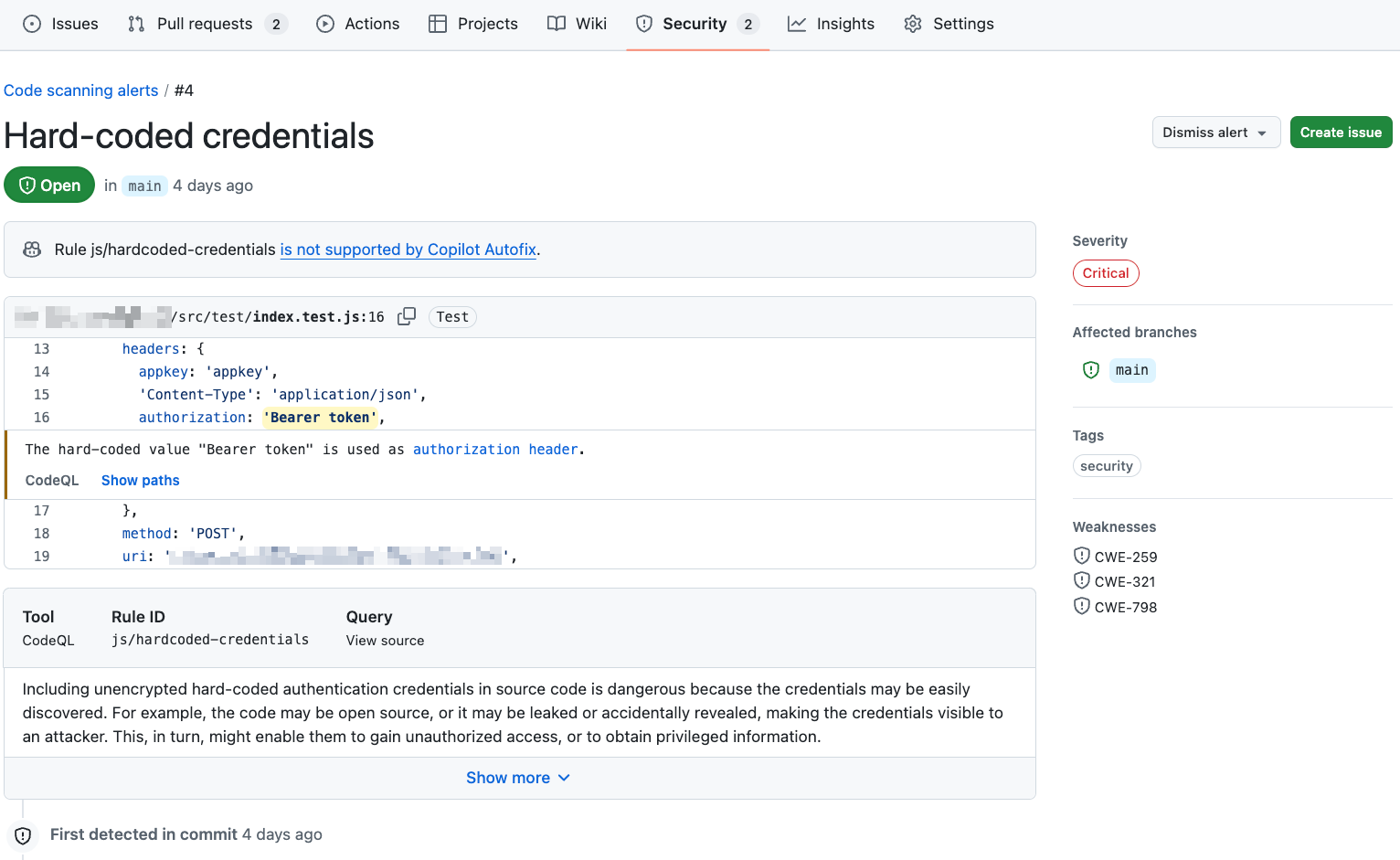
SAST findings with CodeQL
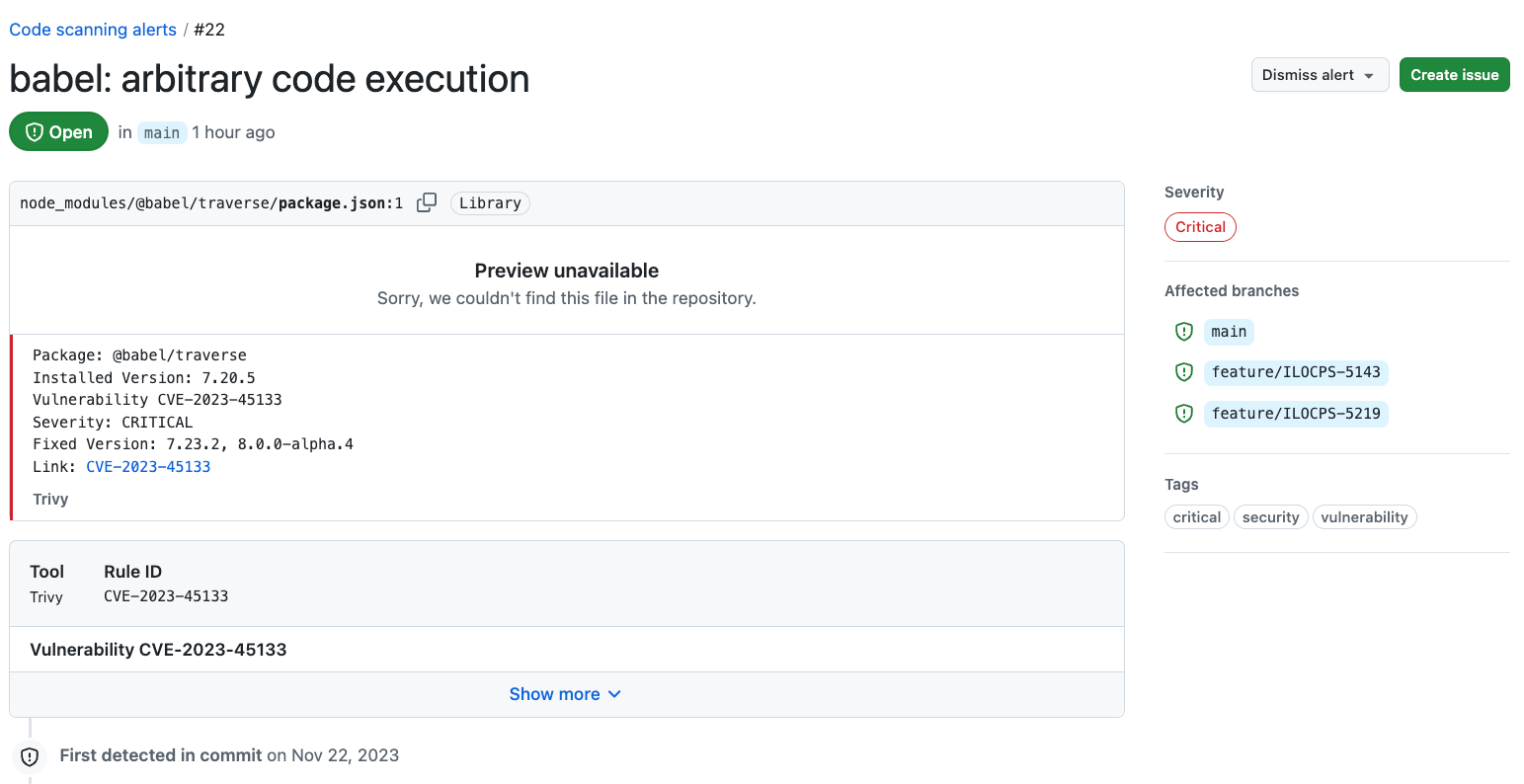
Vulnerable package findings with Trivy
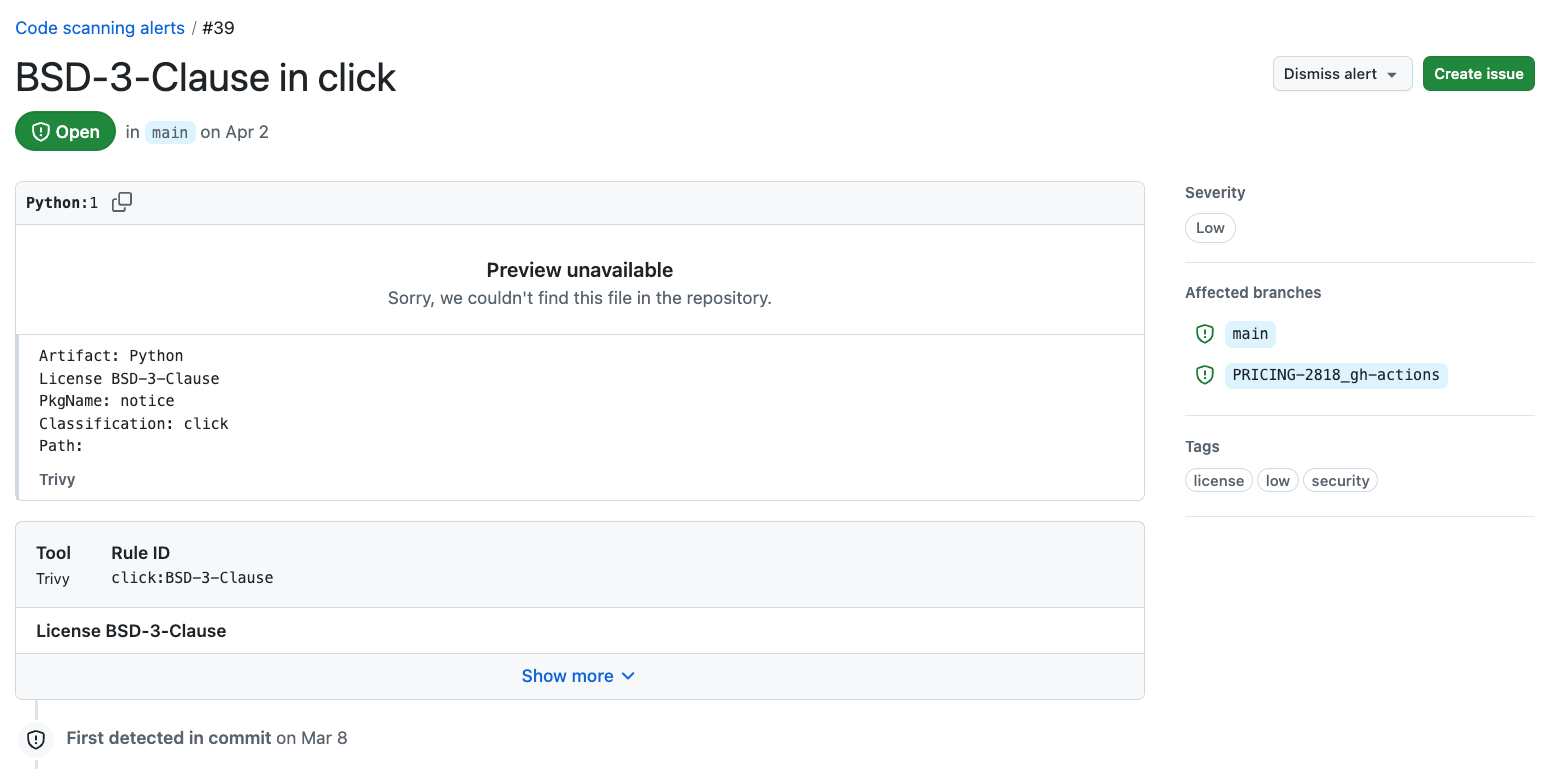
Unknown or forbidden license findings
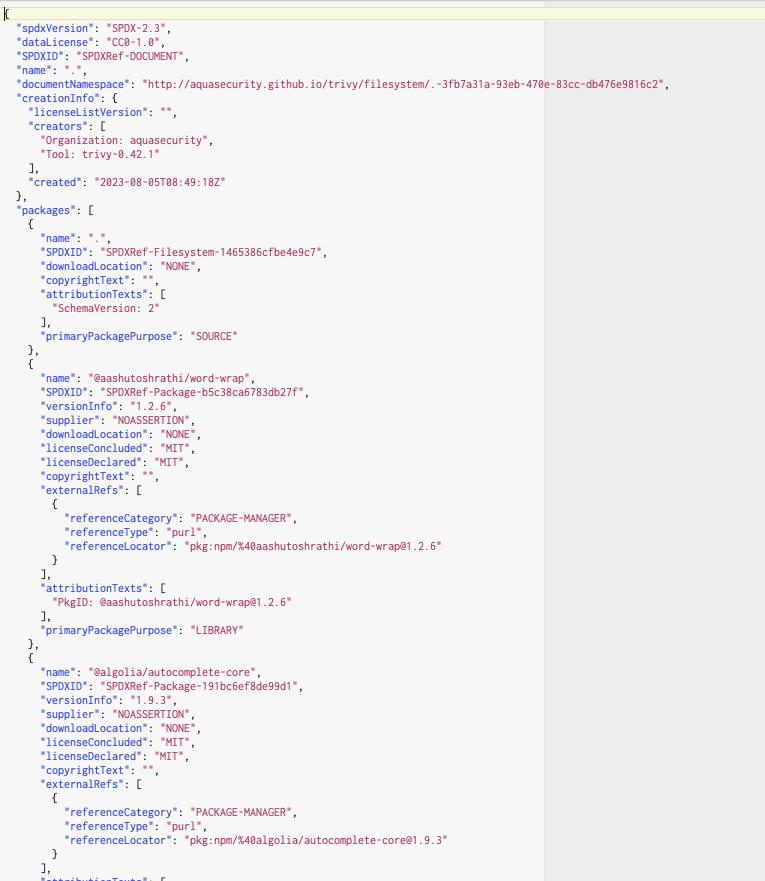
Software Bill of Materials (SBOM) in SPDX format
This workflow uses a CodeQL job. GitHub does not provide a method to break the build with CodeQL, it only reports findings to the Security tab.
It is highly recommended to add a protection rule to your repository which will prevent merging of pull requests that introduce new CodeQL findings of significant severity.
Purpose
This workflow is for node projects that need to scan dependencies for vulnerabilities and licenses that are not allowed by OSPO.
It will also run CodeQL as a SAST tool and produce a Software Bill of Materials (SBOM).
All jobs are integrated with GitHub Advanced Security (GHAS) and will produce findings in the Security tab of your repository.
Usage
Minimal Example
Below is an example of the minimal configuration required to run the workflow. It's based on sensible defaults but will not satisfy all use cases.
To see how to customise the job(s) to work for your case, refer to inputs, secrets and the Additional examples.
jobs:
  node-security:
    uses: erzz/toolbox/.github/workflows/node-security.yml@v1
    # no mandatory inputs
    # no mandatory secrets
Inputs
| Input | Type | Description | Required | Default |
|---|---|---|---|---|
| node-version | string | To version of NodeJS to use | false | 20 |
| install-command | string | Used to override the default command to install your dependencies e.g. yarn install | false | yarn install --silent |
| path | string | Relative path from project root to your node application's source files | false | . |
| codeql-enable | boolean | To disable the CodeQL job set to false | false | true |
| codeql-language | string | One of `javascript` or `typescript`. Determines CodeQL configuration | false | javascript |
| deps-enable | boolean | To disable the dependency scanning job set to false | false | true |
| deps-severity | string | The minimum severity to report | false | MEDIUM,HIGH,CRITICAL |
| deps-timeout | string | The maximum time to wait for the scan to complete | false | 10m |
| licence-enable | boolean | To disable the licence scanning job set to false | false | true |
| licence-default | boolean | To use your own licence configuration set to false and provide a licence-config | false | true |
| licence-config | string | The relative path to your own trivy config file for license scanning e.g. `licenses.yml` | false | licenses.yml |
| sbom-enable | boolean | To disable the SBOM job set to false | false | true |
| artifact-prefix | string | A prefix to apply to the name of the artifacts to upload (useful for matrix builds) | false | null |
| trivy-version | string | Override the version of Trivy (deps/license/sbom) to utilise | false | null |
| trivy-db-cache | boolean | Enable caching of the Trivy DB (deps/license/sbom) | false | true |
Secrets
| Input | Description | Required |
|---|---|---|
| auth-token | Arbitrary token to be exposed as environment variable in the format VARIABLE=value | false |
| auth-token-2 | Arbitrary token to be exposed as environment variable in the format VARIABLE=value | false |
Outputs
| Output | Description | Value |
|---|---|---|
| codeql-artifact-id | The unique id of the codeql SARIF artifact | ${{ jobs.sast.outputs.artifact-id }} |
| codeql-artifact-url | The download URL of the codeql SARIF artifact | ${{ jobs.sast.outputs.artifact-url }} |
| ref-slug | A URL sanitized version of the github ref | ${{ jobs.sast.outputs.ref-slug }} |
| short-sha | Captures the short SHA for use in this or later workflow jobs | ${{ jobs.sast.outputs.short-sha }} |
Configuration Notes
The workflow itself will not provide the scripts and dependencies. It simply executes your commands and provide artifacts if the appropriate dependencies are installed and configured.
Build authentication
Secrets are provided for build-time authentication with private package registries such as Artifactory, NPM etc.
There are options to provide an auth-token and/or auth-token-2 where the environment variable
they are exposed as is configurable.
For example you could expose auth-token: NPM_TOKEN=${{ secrets.SOME_SECRET }} or
auth-token: ARTIFACTORY_AUTH_TOKEN=${{ secrets.SOME_SECRET }} depending on what your build process
requires.
Additional Examples
Disable specific jobs
For example, to disable the licence scanning job:
node-security:
  uses: erzz/toolbox/.github/workflows/node-security.yml@v1
  with:
    licence-enable: false
Custom commands and auth tokens
Most relevant commands are customisable, even with multiple commands using the | syntax. You can
pass in any environment variables you need to the commands for authentication with private package
registries.
node-security:
  uses: erzz/toolbox/.github/workflows/node-security.yml@v1
  with:
    install-command: |
      cp .env.example .env
      npm ci
  secrets:
    auth-token: "NPM_TOKEN=${{ secrets.GH_NPM_AUTH_TOKEN }}"
    auth-token-2: "ARTIFACTORY_AUTH_TOKEN=${{ secrets.ARTIFACTORY_AUTH_TOKEN }}"
Workflow details
Source code
name: NodeJS Security
permissions:
  actions: read
  checks: write
  contents: read
  id-token: write
  security-events: write
  pull-requests: write
env:
  TRIVY_DB_REPOSITORY: public.ecr.aws/aquasecurity/trivy-db:2
  TRIVY_JAVA_DB_REPOSITORY: public.ecr.aws/aquasecurity/trivy-java-db:1
  TRIVY_CACHE_DIR: ${{ github.workspace }}/.cache/trivy
on:
  workflow_call:
    inputs:
      node-version:
        type: string
        description: To version of NodeJS to use
        required: false
        default: "20"
      install-command:
        required: false
        type: string
        description: Used to override the default command to install your dependencies
          e.g. yarn install
        default: yarn install --silent
      path:
        required: false
        type: string
        description: Relative path from project root to your node application's source files
        default: .
      codeql-enable:
        required: false
        type: boolean
        description: To disable the CodeQL job set to false
        default: true
      codeql-language:
        required: false
        type: string
        description: One of `javascript` or `typescript`. Determines CodeQL configuration
        default: javascript
      deps-enable:
        required: false
        type: boolean
        description: To disable the dependency scanning job set to false
        default: true
      deps-severity:
        required: false
        type: string
        description: The minimum severity to report
        default: MEDIUM,HIGH,CRITICAL
      deps-timeout:
        required: false
        type: string
        description: The maximum time to wait for the scan to complete
        default: 10m
      licence-enable:
        required: false
        type: boolean
        description: To disable the licence scanning job set to false
        default: true
      licence-default:
        required: false
        type: boolean
        description: To use your own licence configuration set to false and provide a
          licence-config
        default: true
      licence-config:
        required: false
        type: string
        description: The relative path to your own trivy config file for license
          scanning e.g. `licenses.yml`
        default: licenses.yml
      sbom-enable:
        required: false
        type: boolean
        description: To disable the SBOM job set to false
        default: true
      artifact-prefix:
        type: string
        description: A prefix to apply to the name of the artifacts to upload (useful
          for matrix builds)
        required: false
      trivy-version:
        required: false
        type: string
        description: Override the version of Trivy (deps/license/sbom) to utilise
      trivy-db-cache:
        required: false
        type: boolean
        description: Enable caching of the Trivy DB (deps/license/sbom)
        default: true
    secrets:
      auth-token:
        required: false
        description: Arbitrary token to be exposed as environment variable in the format
          VARIABLE=value
      auth-token-2:
        required: false
        description: Arbitrary token to be exposed as environment variable in the format
          VARIABLE=value
    outputs:
      codeql-artifact-id:
        description: The unique id of the codeql SARIF artifact
        value: ${{ jobs.sast.outputs.artifact-id }}
      codeql-artifact-url:
        description: The download URL of the codeql SARIF artifact
        value: ${{ jobs.sast.outputs.artifact-url }}
      ref-slug:
        description: A URL sanitized version of the github ref
        value: ${{ jobs.sast.outputs.ref-slug }}
      short-sha:
        description: Captures the short SHA for use in this or later workflow jobs
        value: ${{ jobs.sast.outputs.short-sha }}
jobs:
  sast:
    name: CodeQL SAST
    if: ${{ inputs.codeql-enable }}
    runs-on: ubuntu-24.04
    outputs:
      artifact-id: ${{ steps.upload.outputs.artifact-id }}
      artifact-url: ${{ steps.upload.outputs.artifact-url }}
    steps:
      - name: Checkout Source
        uses: actions/checkout@v4
      - name: Setup NodeJS
        uses: actions/setup-node@v4
        with:
          node-version: ${{ inputs.node-version }}
      - name: Export auth token 1
        env:
          TOKEN: ${{ secrets.auth-token }}
        if: ${{ env.TOKEN != '' }}
        run: |
          echo "::add-mask::${TOKEN#*=}"
          echo "${{ env.TOKEN }}" >> $GITHUB_ENV
      - name: Export auth token 2
        env:
          TOKEN: ${{ secrets.auth-token-2 }}
        if: ${{ env.TOKEN != '' }}
        run: |
          echo "::add-mask::${TOKEN#*=}"
          echo "${{ env.TOKEN }}" >> $GITHUB_ENV
      - name: Run install command
        working-directory: ${{ inputs.path }}
        run: |
          ${{ inputs.install-command }}
      - name: Initialize CodeQL
        uses: github/codeql-action/init@v3
        with:
          languages: ${{ inputs.codeql-language }}
      - name: Perform CodeQL Analysis
        id: codeql
        uses: github/codeql-action/analyze@v3
      - name: Upload Reports
        id: upload
        uses: actions/upload-artifact@v4
        if: always()
        with:
          name: ${{ inputs.artifact-prefix }}CodeQL SARIF Report
          path: ${{ steps.codeql.outputs.sarif-output }}
  deps:
    name: Dependency Scan
    if: ${{ inputs.deps-enable }}
    runs-on: ubuntu-24.04
    steps:
      - name: Checkout Source
        uses: actions/checkout@v4
      - name: Install Trivy
        uses: aquasecurity/setup-[email protected]
        with:
          version: ${{ inputs.trivy-version }}
          cache: true
      - name: Create cache directory
        run: |
          echo "Creating Trivy cache directory ${{ env.TRIVY_CACHE_DIR }}..."
          mkdir -p ${{ env.TRIVY_CACHE_DIR }}
      - name: Get current date
        if: ${{ inputs.trivy-db-cache }}
        id: date
        shell: bash
        run: echo "date=$(date +'%Y-%m-%d')" >> $GITHUB_OUTPUT
      - name: Restore DB from cache
        if: ${{ inputs.trivy-db-cache }}
        uses: actions/cache@v4
        with:
          path: ${{ env.TRIVY_CACHE_DIR }}
          key: cache-trivy-${{ steps.date.outputs.date }}
          restore-keys: cache-trivy-
      - name: Execute Scan
        run: |
          trivy --version
          tree ${{ env.TRIVY_CACHE_DIR }}
          trivy repo \
            --format json \
            --output dependency-scan.json \
            --ignore-unfixed \
            --severity ${{ inputs.deps-severity }} \
            --exit-code 0 \
            --timeout ${{ inputs.deps-timeout }} \
            --cache-dir ${{ env.TRIVY_CACHE_DIR }} \
            ${{ inputs.path }}
      - name: Results
        run: >
          if [ $(jq '[.Results[] | .Vulnerabilities | length] | add'
          dependency-scan.json) -gt 0 ]; then
            echo "❌ Vulnerabilities found"
            trivy convert \
              --format table \
              dependency-scan.json
            exit 1
          else
            echo "✨ No vulnerabilities found"
            exit 0
          fi
      - name: Generate SARIF report
        if: always()
        run: |
          trivy convert \
            --format sarif \
            --output dependency-scan.sarif \
            dependency-scan.json
      - name: Upload artifacts
        uses: actions/upload-artifact@v4
        if: always()
        with:
          name: ${{ inputs.artifact-prefix }}Dependency SARIF Report
          path: dependency-scan.sarif
      - name: Upload results to GitHub Security
        if: always()
        uses: github/codeql-action/upload-sarif@v3
        with:
          sarif_file: dependency-scan.sarif
  license-scan:
    name: License Scan
    if: ${{ inputs.licence-enable }}
    runs-on: ubuntu-24.04
    steps:
      - name: Checkout the code
        uses: actions/checkout@v4
      - name: Setup NodeJS
        uses: actions/setup-node@v4
        with:
          node-version: ${{ inputs.node-version }}
      - name: Get Configuration
        if: ${{ inputs.licence-default }}
        run: >
          echo "Fetching default configuration from erzz/toolbox/configs..."

          curl --header 'authorization: Bearer ${{ secrets.GITHUB_TOKEN }}' \
            --header 'Accept: application/vnd.github.v3.raw' \
            --location https://api.github.com/repos/erzz/toolbox/contents/configs/license-scan/licenses.yml \
            --fail \
            --output ${{ inputs.licence-config }} || exit 1
          cat ${{ inputs.licence-config }}
      - name: Export auth token 1
        env:
          TOKEN: ${{ secrets.auth-token }}
        if: ${{ env.TOKEN != '' }}
        run: |
          echo "::add-mask::${TOKEN#*=}"
          echo "${{ env.TOKEN }}" >> $GITHUB_ENV
      - name: Export auth token 2
        env:
          TOKEN: ${{ secrets.auth-token-2 }}
        if: ${{ env.TOKEN != '' }}
        run: |
          echo "::add-mask::${TOKEN#*=}"
          echo "${{ env.TOKEN }}" >> $GITHUB_ENV
      - name: Run install command
        working-directory: ${{ inputs.path }}
        run: |
          ${{ inputs.install-command }}
      - name: Install Trivy
        uses: aquasecurity/setup-[email protected]
        with:
          version: ${{ inputs.trivy-version }}
          cache: true
      - name: Create cache directory
        run: |
          echo "Creating Trivy cache directory ${{ env.TRIVY_CACHE_DIR }}..."
          mkdir -p ${{ env.TRIVY_CACHE_DIR }}
      - name: Get current date
        if: ${{ inputs.trivy-db-cache }}
        id: date
        shell: bash
        run: echo "date=$(date +'%Y-%m-%d')" >> $GITHUB_OUTPUT
      - name: Restore DB from cache
        if: ${{ inputs.trivy-db-cache }}
        uses: actions/cache@v4
        with:
          path: ${{ env.TRIVY_CACHE_DIR }}
          key: cache-trivy-${{ steps.date.outputs.date }}
          restore-keys: cache-trivy-
      - name: Execute Scan
        run: |
          if [ ! -f .trivyignore ]; then
            echo "Creating .trivyignore..."
            touch .trivyignore
          fi
          trivy --version
          tree ${{ env.TRIVY_CACHE_DIR }}
          trivy rootfs \
            --format json \
            --output license-results.json \
            --exit-code 0 \
            --config ${{ inputs.licence-config }} \
            --cache-dir ${{ env.TRIVY_CACHE_DIR }} \
            ${{ inputs.path }}
      - name: Results
        run: >
          if [ $(jq '[.Results[] | .Licenses | length] | add'
          license-results.json) -gt 0 ]; then
            echo "❌ Possible license issues found"
            trivy convert \
              --format table \
              license-results.json
            exit 1
          else
            echo "✨ No license issues found"
            exit 0
          fi
      - name: Generate SARIF report
        if: always()
        run: |
          trivy convert \
            --format sarif \
            --output license-results.sarif \
            license-results.json
      - name: Upload artifacts
        uses: actions/upload-artifact@v4
        if: always()
        with:
          name: ${{ inputs.artifact-prefix }}Licences SARIF Report
          path: license-results.sarif
      - name: Upload results to GitHub Security
        if: always()
        uses: github/codeql-action/upload-sarif@v3
        with:
          sarif_file: license-results.sarif
  sbom:
    name: SBOM
    runs-on: ubuntu-24.04
    steps:
      - name: Checkout the code
        uses: actions/checkout@v4
      - name: Setup NodeJS
        uses: actions/setup-node@v4
        with:
          node-version: ${{ inputs.node-version }}
      - name: Export auth token 1
        env:
          TOKEN: ${{ secrets.auth-token }}
        if: ${{ env.TOKEN != '' }}
        run: |
          echo "::add-mask::${TOKEN#*=}"
          echo "${{ env.TOKEN }}" >> $GITHUB_ENV
      - name: Export auth token 2
        env:
          TOKEN: ${{ secrets.auth-token-2 }}
        if: ${{ env.TOKEN != '' }}
        run: |
          echo "::add-mask::${TOKEN#*=}"
          echo "${{ env.TOKEN }}" >> $GITHUB_ENV
      - name: Run install command
        working-directory: ${{ inputs.path }}
        run: |
          ${{ inputs.install-command }}
      - name: Install Trivy
        uses: aquasecurity/setup-[email protected]
        with:
          version: ${{ inputs.trivy-version }}
          cache: true
      - name: Create cache directory
        run: |
          echo "Creating Trivy cache directory ${{ env.TRIVY_CACHE_DIR }}..."
          mkdir -p ${{ env.TRIVY_CACHE_DIR }}
      - name: Generate SBOM
        run: |
          trivy --version
          trivy repo \
            --format spdx-json \
            --output sbom.spdx.json \
            ${{ inputs.path }}
      - name: Upload artifacts
        uses: actions/upload-artifact@v4
        if: always()
        with:
          name: ${{ inputs.artifact-prefix }}SBOM
          path: sbom.spdx.json
Job definitions
| Step | Uses | Conditional |
|---|---|---|
| Checkout Source | actions/checkout@v4 | false |
| Setup NodeJS | actions/setup-node@v4 | false |
| Export auth token 1 | script | true |
| Export auth token 2 | script | true |
| Run install command | script | false |
| Initialize CodeQL | github/codeql-action/init@v3 | false |
| Perform CodeQL Analysis | github/codeql-action/analyze@v3 | false |
| Upload Reports | actions/upload-artifact@v4 | true |
| Step | Uses | Conditional |
|---|---|---|
| Checkout Source | actions/checkout@v4 | false |
| Install Trivy | aquasecurity/[email protected] | false |
| Create cache directory | script | false |
| Get current date | script | true |
| Restore DB from cache | actions/cache@v4 | true |
| Execute Scan | script | false |
| Results | script | false |
| Generate SARIF report | script | true |
| Upload artifacts | actions/upload-artifact@v4 | true |
| Upload results to GitHub Security | github/codeql-action/upload-sarif@v3 | true |
| Step | Uses | Conditional |
|---|---|---|
| Checkout the code | actions/checkout@v4 | false |
| Setup NodeJS | actions/setup-node@v4 | false |
| Get Configuration | script | true |
| Export auth token 1 | script | true |
| Export auth token 2 | script | true |
| Run install command | script | false |
| Install Trivy | aquasecurity/[email protected] | false |
| Create cache directory | script | false |
| Get current date | script | true |
| Restore DB from cache | actions/cache@v4 | true |
| Execute Scan | script | false |
| Results | script | false |
| Generate SARIF report | script | true |
| Upload artifacts | actions/upload-artifact@v4 | true |
| Upload results to GitHub Security | github/codeql-action/upload-sarif@v3 | true |
| Step | Uses | Conditional |
|---|---|---|
| Checkout the code | actions/checkout@v4 | false |
| Setup NodeJS | actions/setup-node@v4 | false |
| Export auth token 1 | script | true |
| Export auth token 2 | script | true |
| Run install command | script | false |
| Install Trivy | aquasecurity/[email protected] | false |
| Create cache directory | script | false |
| Generate SBOM | script | false |
| Upload artifacts | actions/upload-artifact@v4 | true |
Configuration Files
They are provided to get you started with sensible defaults. It's OK to replace them in order to tweak for your own preferences if required.